Talk: Cultural Darning: Rewilding with People and Place, The Big Picture Conference, Scotland’s Rewilding Event
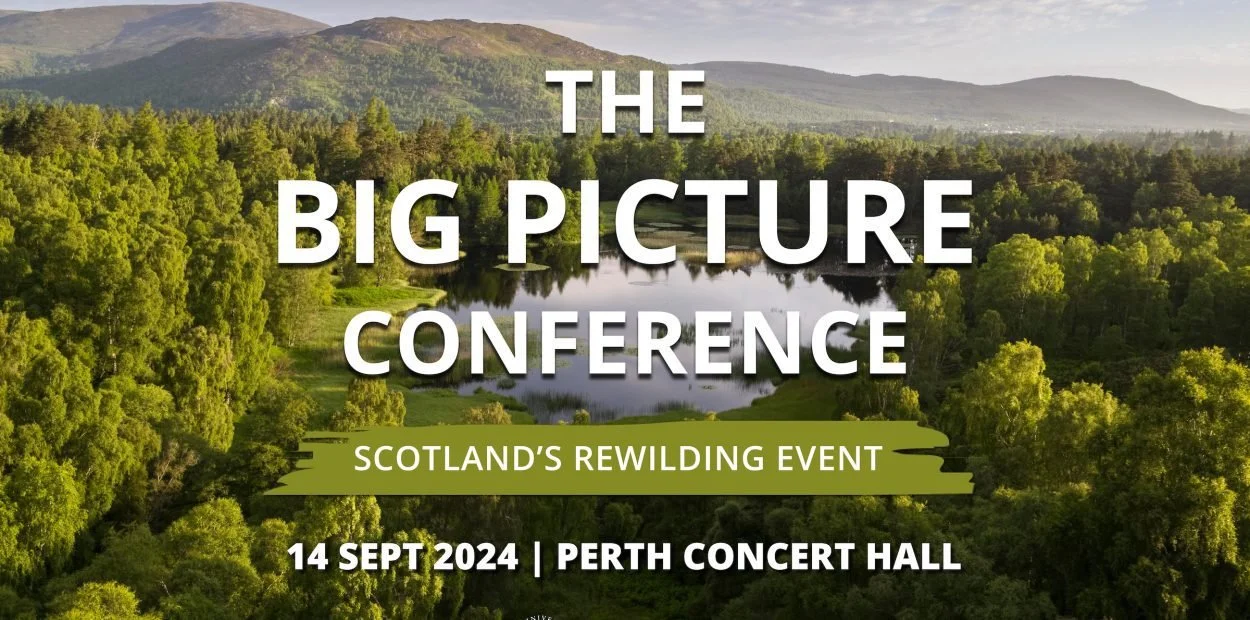
This text is adapted from a talk given at ‘The Big Picture Conference,’ Scotland’s Rewilding Event which took place in Perth Concert Hall on Saturday 19th September 2026
In the hills above the forest where I live, above Loch Ness, beavers are busy reshaping an old shieling landscape. For generations, people and cattle made the summer journey from the township to these higher pastures, in the seasonal rhythm of the imrich chun na h-àirigh. Nearby, prehistoric cup-marked stones and the remains of hut circles carry traces of people living in and moving through this place thousands of years before.
The ways people have lived with and worked this land have changed over time - from the shielings to crofting and common grazing, from estates to plantation forestry, and, since the 1990s, community ownership. Today, nearly three decades of collective stewardship have seen native woodland restored alongside a working forest, with new paths and trails opening the land up for walking, biking, learning and play. It is a landscape that has been made and remade over and over: and now beavers are part of that remaking, creating new wetlands and habitats of their own.
I was invited this week to speak at The Big Picture conference about cultural heritage, creativity and community, as part of a panel Rewilding with People and Place. I don’t come from a conventional ecology or conservation background; my way into these questions is through ethnology and human ecology – through how people come to know places, how culture shapes and creatively expresses those relationships, how we make meaning. I often work with artists and with musicians, and with Tobar an Dualchais – Kist o Riches, Scotland’s largest online archive of oral tradition in Gaelic, Scots and English - music, songs, stories, folklore, traditional knowledge, custom and belief. You can get lost in there for days.
Tobar an Dualchais translates into English as ‘The Well of Heritage.’ This word ‘heritage,’ though, sounds like something removed or apart from the present: something from the past, to be preserved, curated or performed. The idea of living heritage - or UNESCO intangible cultural heritage - tries to capture something more fluid: culture as actively practised, passed between generations. The folklorist used the lovely metaphor of the ‘carrying stream’ to express a living flow of culture, carrying memory forward, while remaining open to new voices, new ideas and new creative possibilities.
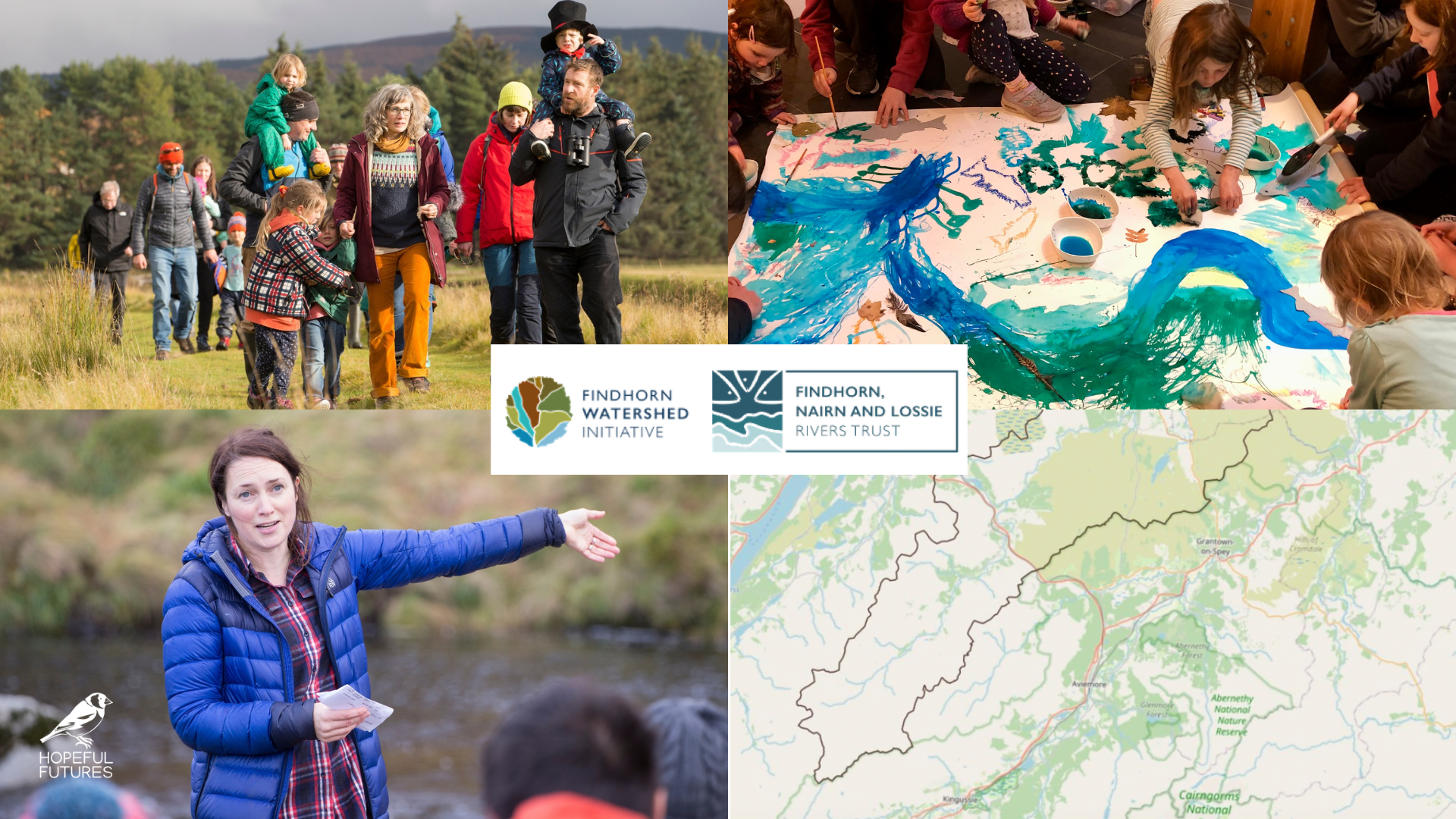
Speaking of carrying streams, in recent years I’ve been working as a Researcher-in-Residence with the Findhorn Watershed Initiative, part of the Findhorn, Nairn and Lossie Rivers Trust, alongside my collaborator artist Raghnaid Sandilands. We explored the human ecology of the River Findhorn through placenames, music, song, story and local knowledge - asking what these fragments of cultural memory might reveal about people’s relationships with the river and its wider watershed, and how bringing them back into living practice might help foster new relationships of attention, connection and care. We shared what we found through gatherings, music, walks, podcasts and publication.
That work also fed into a British Academy policy discussion paper I co-wrote on integrating intangible cultural heritage and traditional ecological knowledge into place-sensitive nature recovery. The argument we make is simple: lasting environmental stewardship depends upon connection between people and place. It depends upon relationships that foster a sense of belonging, attention, responsibility, and care. That is to say, as Elle Adams articulates, nature recovery is as much about our human relationships with nature as it is about the practical work of restoration itself.
Cultural heritage offers a wonderful way to nurture those connections. Music, song, story and poetry are creative expressions of our relationships with place; cultural memory carries ecological knowledge accumulated through generations of close attention to land and sea, weather and seasons, flora and fauna. Anthropologists have long questioned the distinction we tend to make between ‘culture’ and ‘nature’, and the ways it can obscure how human lives, knowledge and practices have developed in relationship with the living world. Donna Haraway, a feminist scholar of science and technology, gives us the useful term naturecultures – deliberately running the two words together to capture how deeply entangled they are, continually shaping and making one another.
A related idea, increasingly influential in research and policy, is biocultural diversity: the recognition that cultural and biological diversity are deeply intertwined. And so, cultural loss and ecological loss are also intertwined. As we live through the climate and ecological crisis, we are witnessing the fraying of that whole fabric.
This fraying is bound up with histories of power, dispossession, displacement and extraction. Rewilding, as a global movement, is therefore inevitably bound up with questions of culture, power and justice. Who owns the land? Who benefits from its restoration? Who gets to shape its future? Whose knowledge and ways of knowing are valued, and what histories are carried forward - or erased?
Within the context of the Highlands and Islands, these questions carry particular historical weight. The cultural-ecological fabric of this place was profoundly and violently ruptured through Clearance, enclosure, dispossession - fracturing relationships between people and place, reshaping who could live on, know and care for the land. Acknowledging this history isn’t about returning to an imagined past, but about recognising what has been lost, what has survived, and how those histories continue to shape the present - in patterns of ownership and agency, in whose knowledge is recognised, and in whose memories and ways of knowing are carried forward.
My friend Amy Clarkson explores some of these tensions in her gorgeous PhD, Oak Thorn Kin. She writes:
In this UN declared decade of ecological restoration, large scale conservation efforts, and in particular tree planting schemes, risk negating sensitivity to places and peoples through the urgency to sequester carbon, while biodiversity loss is treated separately from matters of social justice.
Amy now works for Affric Highlands, a landscape-scale rewilding initiative. I find a real kinship with her idea of reciprocal restoration, which grew from her experience of tending woodland at Àirigh Drishaig in Applecross. She asks what happens when restoration becomes more than something we enact upon ecosystems, and instead something we participate in, and are ourselves transformed by. She describes it as ‘an adaptive practice threaded through a story of place, made, and remade continuously.’
Reciprocal restoration is attentive to place and acknowledges histories of extraction and loss while imagining different ecological futures. It allows us to ‘stay with the trouble,’ to borrow Haraway’s phrase - to honour grief, complexity and contradiction, while working towards possibilities of regeneration. Reciprocity here works on two levels: it shapes how we practicse restoration now, through attention, participation and responsiveness to the living place; and in Amy’s context of Àirigh Drishaig, it is also about remembering relational ways of knowing and being, in which human life was understood as entangled with a more-than-human world.
In the Gàidhealtachd, something of that relationality is carried in the Gaelic concept of dùthchas. This is a very old word, rooted in dùth, meaning earth or land. It has no easy translation, but has been described as an ‘existential sense of being in place,’ grounded in generations of custodial relationship. Within this worldview, care for land was embedded within moral, imaginative and intergenerational systems of meaning. We find this throughout folk belief: ideas about reciprocity, restraint, and how to live well on the land alongside more-than-human life. It’s expressed beautifully in fairy belief - I wish we had time for that today!
As many of you will know, dùthchas as an idea is already finding its way into rewilding discourse as a way of expressing the intertwining of people, land, nature and culture, and connecting this with ideas of community agency, ownership and land justice.
How do we make this meaningful in practice? How might cultural and creative practice help deepen people’s relationships with place, and inspire a desire to care for it?
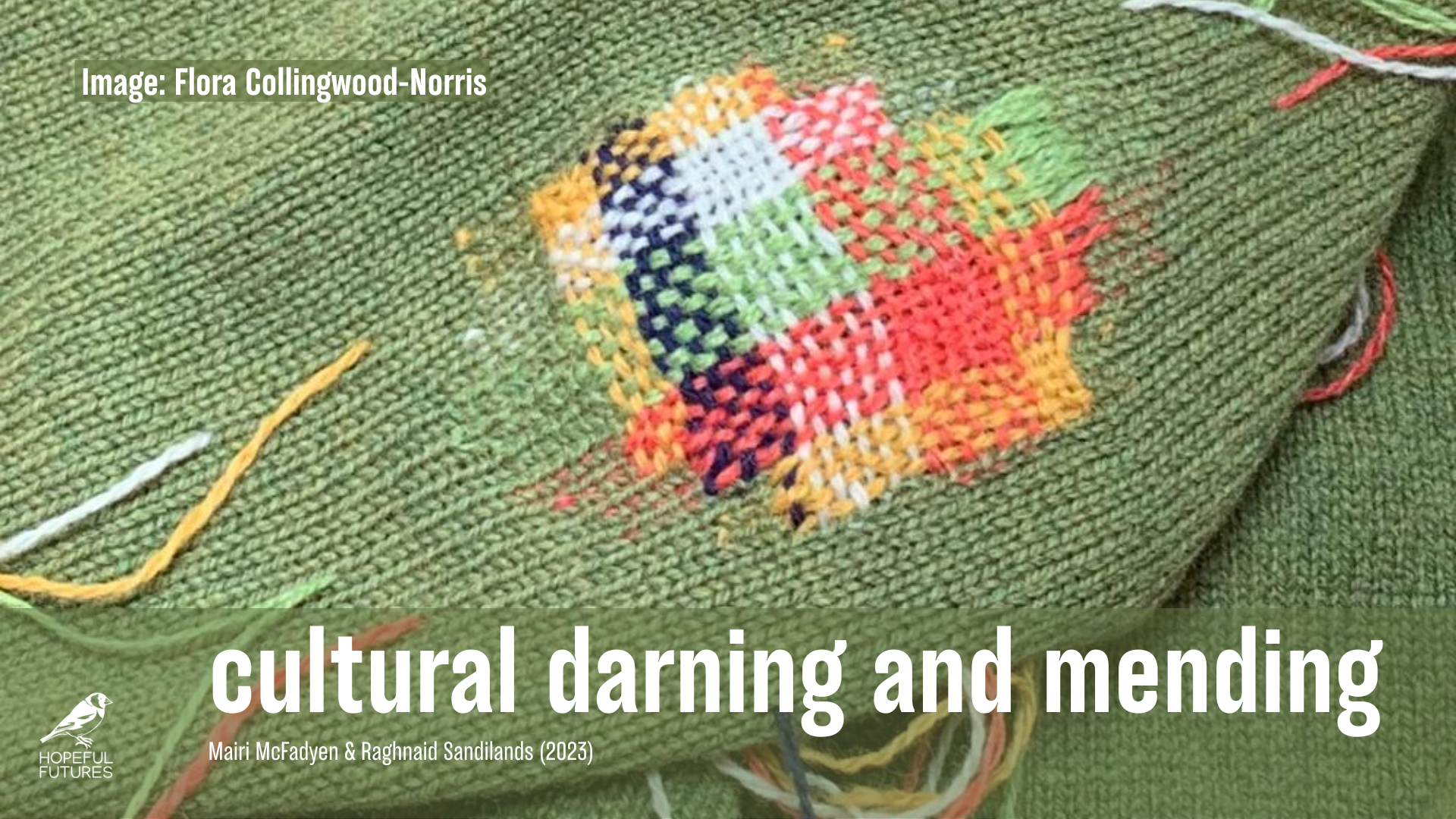
I describe my own creative practice as cultural darning and mending. It’s about finding the disparate threads of cultural memory and carefully darning them back into the ongoing story of a place, into the living fabric, if you like. The metaphor of darning has been chosen carefully; a darn does not return material to some original perfection - the repair remains visible, carrying the memory of what has been damaged or lost, while adding something new, intentional, and brightly coloured, perhaps.
It can begin very simply, with a map and a placename, a fragment of song, a memory, finding ways to bring them back into living practice. As Raghnaid Sandliands writes, ‘there is a measure of kindness and care in mending and fixing and returning these stories to their places.’
Following these threads can also become a decolonial practice of disentangling. Pulling at the thread of a placename or song doesn’t simply recover a lovely piece of local culture; sometimes that thread leads into much bigger knotted histories - of Clearance, dispossession and loss; of land and ownership; of whose knowledge became authoritative and whose slipped from view.
Cultural darning in much in common with Amy’s reciprocal restoration. It begins with situated knowledge - with paying attention to a particular place, and recognising the different relationships, experiences and ways of knowing held there. It values relation and reciprocity, and asks us to notice questions of power: whose knowledge is heard, whose is overlooked, and who has a say in the future of a place. It also shifts the idea of repair away from a return to some imagined nostalgic past and instead towards an ongoing practice of care.
We cannot mend the whole fabric, but we can make small, careful stitches - hopeful acts of repair that invite people into relationship with the land, its past, its present, its futures.
We brought this creative practice to our research residency with the Findhorn Watershed initiative.
In the upper reaches of the Uisge Èirinn, the landscape can feel extraordinarily empty, but the placenames tell a different story. Along the tributaries running off the Monadh Liath into the Findhorn, the sheer abundance and intricate detail of the naming reveals a remarkable depth of attention to place. Even the smallest watercourses were known and named. As Raghnaid has written before, the word caochan refers to the smallest streamlet, defined as ‘a fine moorland rivulet, a purling rill.’ Derived from the old Gaelic caeich, meaning blind, one interpretation is that these rills are named from the perspective of the land – ‘small blind one,’ so embedded in the moor that it cannot see out of its own bed (as well as, perhaps, being obscured from human sight). The tributaries flowing into the river Findhorn are rich with such names, 86 in total. Caochan a’ Choire Sheilich, of the corrie of the willow; Caochan a’ Chrithinn, of the aspen; Caochan Clais nan Eun, of the hollow of the birds; Creag na h-Iolaire, the crag of the eagle. You can see the full map and key on the website.
Gaelic placenames like this carry stories of habitats, offering clues to past ecologies, but also expressions of ecological relationship. Landscapes that might appear empty become full of meaning. In this sense, placenames can open up whole worlds of memory, and invite us into different ways of seeing. I think there is something quietly radical too in this way of seeing a river. Our attention is usually drawn to the main channel, the great river running through the landscape. These names take us in the other direction, following the water outwards into its smallest tributaries, paying attention to small things that dominant ways of seeing tend to overlook.
To understand that the upper reaches of the watershed was once an ecologically diverse landscape, known and named by people who had an intimate knowledge of their place, can help us imagine what this landscape could look like again. And this ecological knowledge can directly inform efforts toward restoration.
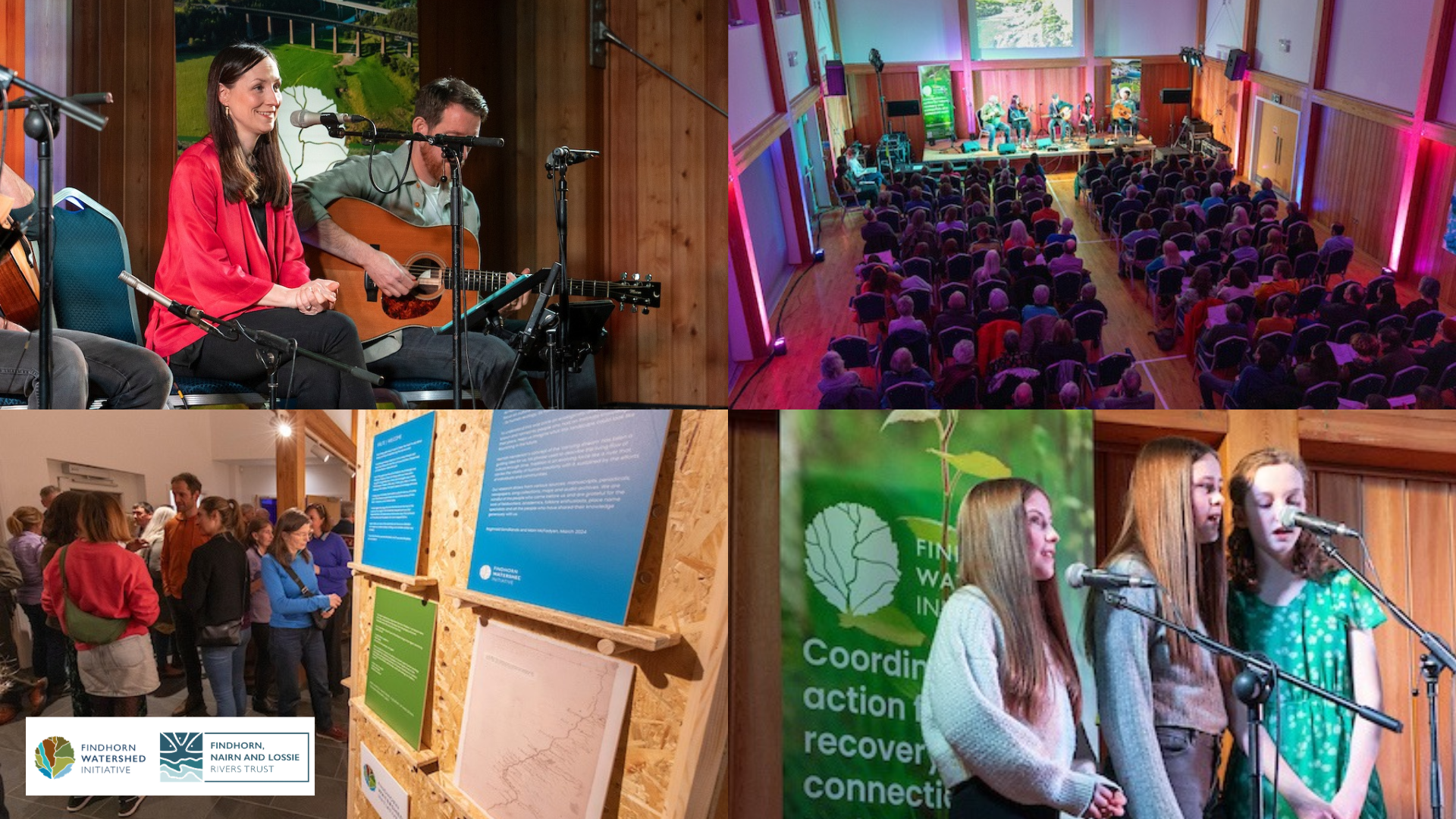
Placenames were only one thread in this rich cultural landscape. Music, song, story and poetry carry rich cultural memory too. At a gathering in Tomatin, we offered our research back to the local community through an event and exhibition, joined by some talented and generous musicians. Following the course of the river, we shared fiddle and pipe tunes connected to the strath, alongside Gaelic songs that remembered the sun on the river, the wind from the heights, and the grief and love that happened here. Some had not been sung for hundreds of years; some had survived only as fragments in manuscripts, their melodies lost, and were re-paired with new tunes. We also shared new music, including a tune composed from the perspective of the last wolf, who was famously shot by Donald MacQueen on the River Findhorn in 1743, just three years before the Battle of Culloden.
For some people in the room, it was a revelation that this cultural landscape existed here at all. Here, an awareness of loss itself can inspire deeper, more meaningful relationships with the landscape.
In Abriachan, darning and mending looks a little different. We already benefit from nearly three decades of community ownership, care and nature restoration here. Cultural heritage has always been part of that. I see my work here as carrying some of that memory forward, and remaking it with a new generation.
We have some wonderful placenames at home in Abriachan too - wildcats and deer, meadow pipits and berries, shielings, smithies, fairies and giants, I can’t resist sharing just a few!
Allt an Daimh Ruaidh - the stream of the red deer stag
Glac na Greighe - the hollow of the deer herd
Creag a’ Chait - the rock of the wildcat
Cnoc Snàtaig - the hill of the meadow pipits
Allt Lòn na Fiodhaige - the stream of the bird-cherry meadow
Glac Dhubh nan Dearcag - the black hollow of the berries
Allt na h-Àiridh - the stream of the shieling
Lochan na Ceàrdaich - the lochan of the smithies
Slochd am Famhair - the pit of the giant
Glac Ossian - Ossian’s hollow
Creag nan Sìthean - the rock of the fairies
This year, at the threshold of summer, I hosted a community walk for the Abriachan Forest Trust celebrating the summer flit of people and cattle to the high pastures of the summer shieling. The day was named after a famous Gaelic nature poem ‘Òran an t-Samhraidh’ (‘Song of the Summer), written by Alasdair mac Mhaighstir Alasdair (c. 1698-1770).
Over forty of us walked up through the forest in May sunshine, with a cuckoo calling, noticing and naming as we went. Ryan Dziadowiec guided us through the history of summer life on the hill and the ways people once relied on the surrounding landscape, which would have been intimately familiar to those who spent each year on the hill from Beltane to harvest. We were so lucky to have Ruairidh MacIlleathain with us too, who shared his deep knowledge of Gaelic plant lore – from whom so many of us have learned so much. The children now know their louseworts from their milkworts, and the magic of the lus an ìme, or mòthan, the butterwort. We listened for birds too: the ceileiriche, the willow warbler; the tiny crìonag-bhuidhe, the goldcrest; and breacan-beithe, the chaffinch, its Gaelic name meaning speckled one of the birch.
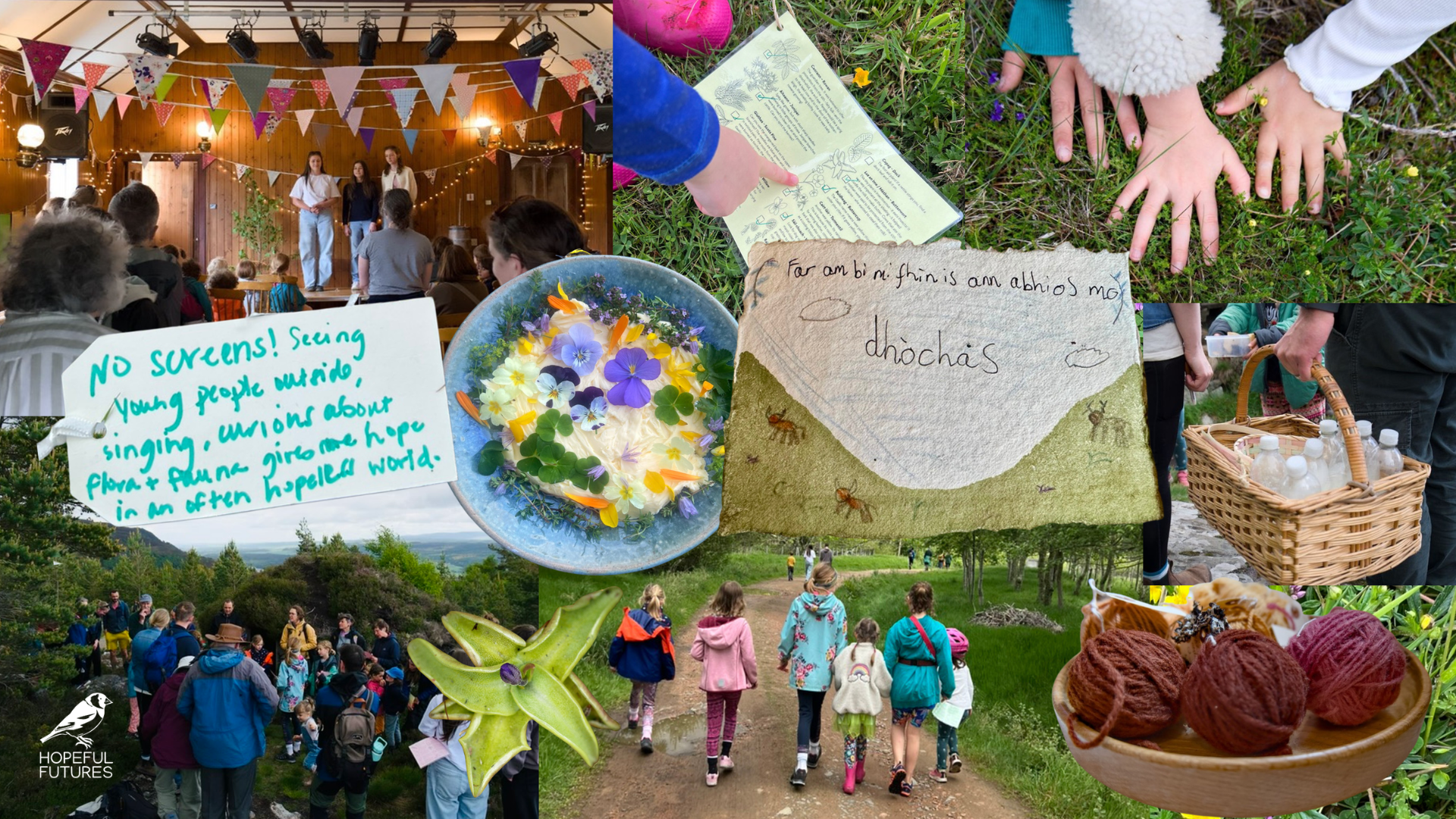
On our way back down the hill, we got to work making our own butter with bottles of cream, which our youngest participants enthusiastically shook until the cream turned yellow – ready for oatcakes, pancakes and a pot of soup back at the village hall. We enjoyed art-making and plant printing with Katie, who grew up here. A display brought together maps of placenames, traditional butter churns and examples of local craft knowledge including baskets, and wool dyed with natural lichen, all generously shared by community members. Young Gaelic song group Ealtainn sang traditional shieling songs for us, and the local children sang a wee hopeful song: ‘Far am bi mi fhìn is ann a bhios mo dhòchas’ / where I will be is where my hope will be.
We laughed at the fact that the old shieling grounds at Rivoulich (Ruigh a’ Mhullaich - shieling of the upland) are now home to beavers — and some of the children walking with us had even been there to watch them being released.
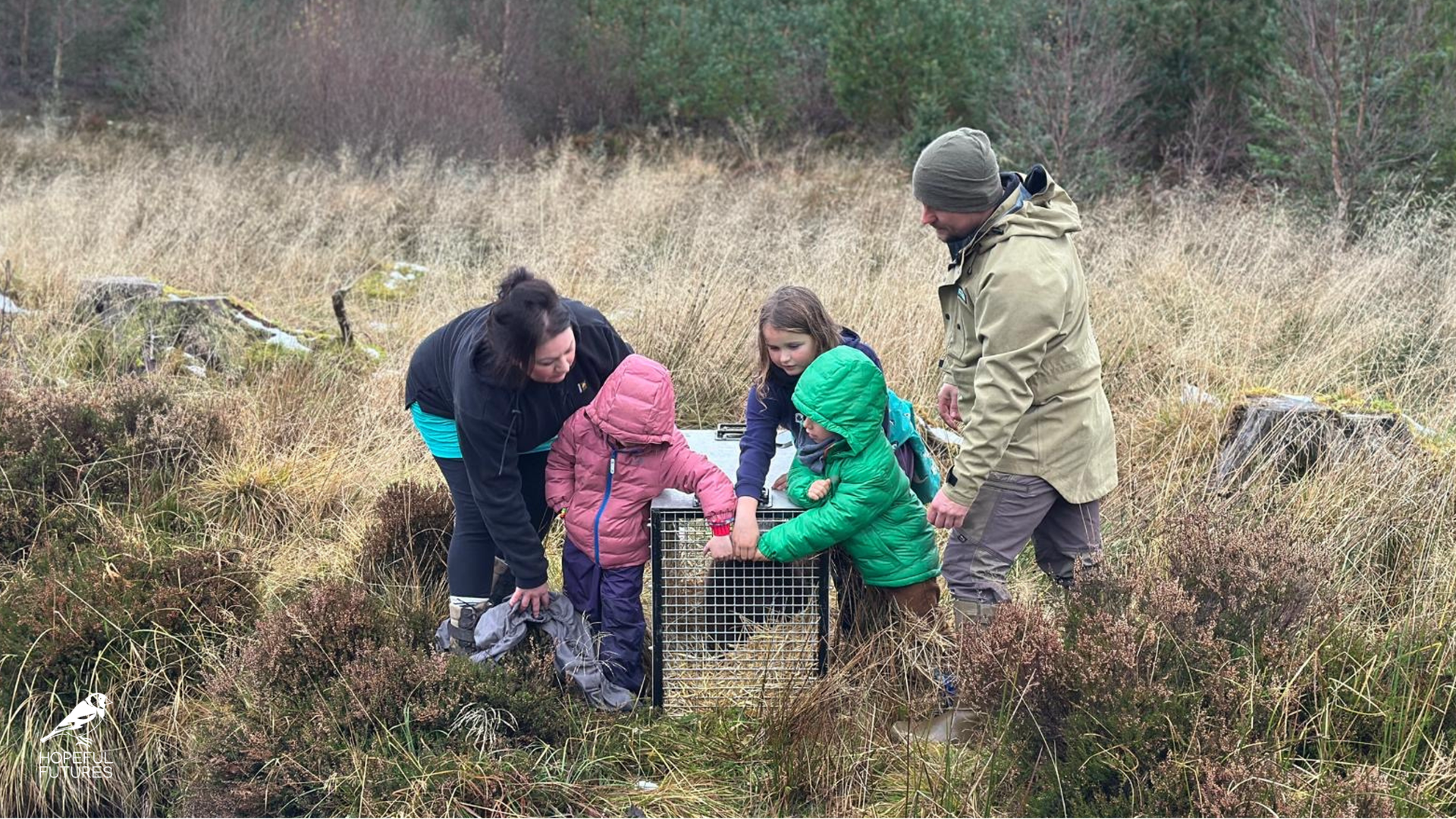
Abriachan is a hopeful story of what becomes possible for both community and biodiversity when people have agency in a place. It is a landscape that continues to be remade, with local people caring for it, learning from it and living alongside the other species remaking it too.
Perhaps repair begins with small invitations into relationship with the living world - an invitation to notice, to pay attention, to learn something of a place, to participate in its ongoing life. These are small, humble things, but they matter: they are ways of coming to know a place deeply enough to love it, and to love it enough to care for it - to steward it into the future.
Many of today’s efforts to restore Highland ecosystems are taking place in landscapes where land may be carefully managed and protected, yet remain disconnected from community. The scale of the ecological crisis demands ambitious action, but a rewilded landscape in which people have little meaningful agency, connection or stake in its future offers a very limited vision of recovery. It serves to deepen the disconnect that caused so much damage in the first place. Rebuilding relationship has to be part of the work: renewing reciprocal relationships between people and place, within communities, and with the more-than-human world.
This is why cultural heritage - why living heritage - is so important. Cultural heritage carries memory and knowledge of how people have known, inhabited and cared for places across generations; creative practice allows those relationships to be made and remade in the present, with new voices; and community is where these relationships are lived and sustained. Reciprocity also means making space for other species and living systems to shape landscapes in ways of their own.
As Amy Clarkson asks,
‘What if it is the ground we stand on, and the relationships we form there, that make and remake the world?
Ecological restoration must enfold the embodied experience. Our participation laces the human community into relation with the more-than-human world: the common ground of our earthly relationships…trusting that there will be someone, some kin, to carry it on.’
I find this an enormously hopeful thought. Cultural darning and mending asks us to trust in something similar: to make our own small, careful stitches into the places we love, knowing that others came before us, and trusting that some other kin will carry it on after us.
Perhaps this is the real promise of rewilding: the possibility of richer ways of inhabiting the world, sustained across generations.